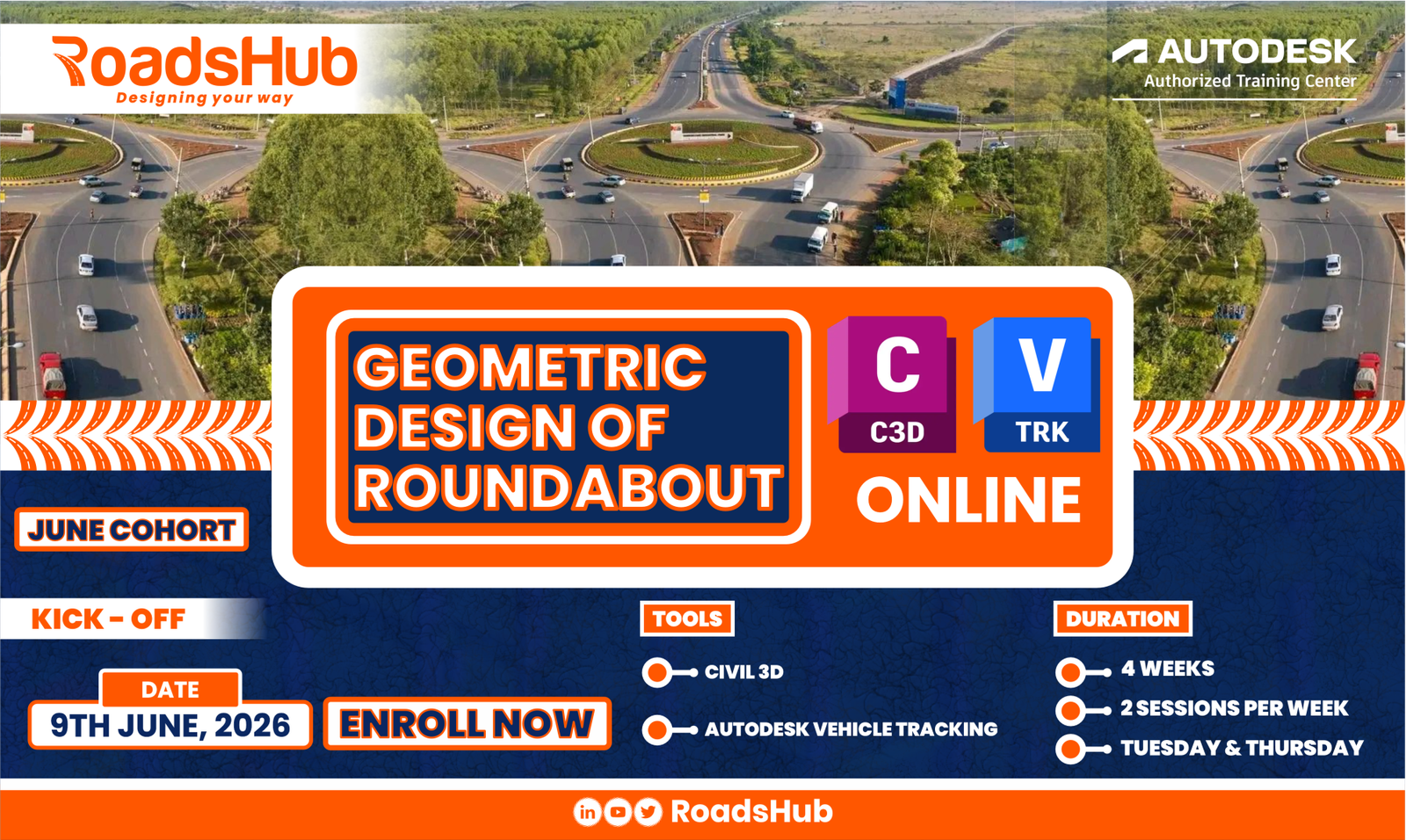
About Course
Become a Confident Roundabout Design Engineer in Just 4 Weeks!
Kick off: June 9, 2026
Master modern roundabout geometric design using AASHTO, FHWA, Kenya RDM 2025 and IRC standards. Experience world-class delivery and a hands-on Civil 3D and Vehicle Tracking training by Eng. James Murithi. You will receive a globally recognized Autodesk certificate of Completion.
Why roundabout design matters — and why this course
The modern roundabout is one of the fastest-growing intersection types worldwide, and for good reason. When they are well designed, roundabouts reduce conflict points, improve safety, and serve both motorized and non-motorized users better than almost any alternative.
But getting the design right isn’t trivial.
Selecting a roundabout, sizing it correctly, verifying swept paths, and producing compliant documentation all require a structured understanding of both the principles and the practical tools.
That’s exactly what this course delivers.
This 4-week program walks you through the complete geometric design process for modern roundabouts — from the initial selection decision through to a professional book of drawings and a design report.
By combining course material with global design standards and engineering judgment, you’ll be equipped to produce plans that genuinely benefit the communities they serve.
4-Week Curriculum: Modern Roundabout Design Step by Step
Each week builds on the last — from theory and selection criteria, through geometry and software modelling, to final documentation. No filler, no detours.
|
WEEK 1 |
Roundabout Fundamentals & Global Design StandardsThese are the questions many have when presented with such a project at work: Why roundabouts? When are they appropriate? What do the manuals actually require? This week builds the foundation — the design philosophy, selection criteria, and the standards you will reference throughout your career. |
WEEK2 |
Geometric Design & Swept Path AnalysisYou will start with sizing the inscribed circle, set entry and exit radii, design splitter islands, and then verify your geometry with real swept path simulations. You will run vehicle tracking for buses, articulated trucks, and design vehicles before finalizing a single dimension. |
|
WEEK 3 |
Civil 3D Modelling — Corridors, Surfaces & GradingYou will move from a geometric 2D sketch to a full 3D model. Build horizontal alignments, create corridor assemblies, model the roundabout surface, and extract earthwork quantities — all inside Civil 3D’s roundabout workflow. |
|
WEEK 4 |
Drawings, Documentation & Capstone ProjectProduce a complete, professional design package. Plan and profile sheets, quantity schedules, traffic control layout, and a written design report — then apply everything to the capstone project and sit the multiple-choice assessment. |
REFERENCED STANDARDS
Designed for Global Practice
Most courses teach one standard, which limits where you can work. This course references over five international manuals — so you are prepared for projects across Africa, South Asia, Europe, and North America.
|
🇺🇸 AASHTO A Policy on Geometric Design of Highways and Streets (Green Book) |
🇺🇸 FHWA Roundabouts: An Informational Guide — Federal Highway Administration |
🇰🇪 Kenya RDM Kenya Road Design Manual — geometric design standards |
🇮🇳 IRC Indian Roads Congress roundabout design guidelines |
🇬🇧 UK TD 16 Design of Roundabouts — UK Design Manual for Roads and Bridges |
Everything Included — All Resources Provided from Day One
You Bring the Drive. We Bring Everything Else.
From day one, you have access to every resource you need. No hunting for templates, data, or reference files — just focused learning.
✔ Step-by-step video lessonsScreen-recorded walkthroughs of every Civil 3D and Vehicle Tracking workflow — replayable at your own pace. |
✔ Civil 3D project filesReal datasets and starter files so you are working with project-grade data from lesson one. |
✔ Drawing templatesStandards-compliant Civil 3D sheet sets and title blocks ready for professional submission. |
✔ Design QA checklistsReview your work against the same checklist a senior engineer uses before issuing drawings. |
✔ Manual summaries & excerptsCondensed key clauses from all five referenced international standards. |
✔ Capstone projectA complete roundabout design exercise that consolidates everything from all four weeks. |
✔ Multiple-choice assessmentAn end-of-course evaluation designed to verify your understanding of the course materials. |
✔ Globally recognized certificateA digital Autodesk Certificate of completion to add to your professional portfolio and LinkedIn profile. |
WHO THIS IS FOR
Built for Practising Engineers and Designers
This course is designed for working professionals who want to add roundabout design to their technical toolkit
- Civil and transport engineers who want to specialize in intersection and roundabout design
- Highway designers working on projects worldwide
- Engineers familiar with Civil 3D who want to extend into intersection design and swept path analysis
- Consultants and road agencies who need staff trained to global roundabout design standards
- Recent graduates wanting to accelerate their infrastructure design career with a specialist certificate
- Designers who have been using rules of thumb and want to ground their practice in documented standards
Quick Answers Before You Commit
Do I need prior Civil 3D experience to enroll?Intermediate Civil 3D experience is required. Every Civil 3D workflow is demonstrated step-by-step with screen recordings, so you can follow along. A strong understanding of road geometry basics will help you get the most out of the course. |
What version of Civil 3D and Vehicle Tracking is used?The course is delivered using Civil 3D 2026 and Autodesk Vehicle Tracking 2026. The methods and workflows are fully compatible with Civil 3D 2023 and later. We will provide an Autodesk license for the duration of training |
Is this course relevant outside Kenya or the US?Absolutely. The course is explicitly built around five international standards — AASHTO, FHWA, Kenya RDM, IRC, and UK TD 16. The geometric principles translate directly across contexts, and you will learn to apply whichever standard governs your project jurisdiction. |
How much time do I need to commit each week?Plan for approximately 6–8 hours per week, covering video lessons, hands-on Civil 3D practice, and review exercises. The course is live for two days, TUESDAY AND THURSDAY, from 8:00 pm to 10:00 pm. You will need an extra 4 hours per week for deliberate practice. |
What is the capstone project?The capstone is a complete roundabout design exercise where you take a realistic project brief from initial selection through to a professional book of drawings and a design report. It consolidates all four weeks of learning into one integrated deliverable and forms part of your assessment for the certificate. |
How is the certificate awarded?On completing the capstone project and passing the multiple-choice assessment at the end of week 4, you receive a globally recognized Autodesk and RoadsHub digital certificate of completion. The certificate can be downloaded, shared on LinkedIn, and added to your professional portfolio. |
Do I need Autodesk Vehicle Tracking separately from Civil 3D?Yes — Vehicle Tracking is a separate Autodesk product, though it integrates directly into Civil 3D. It is included in Autodesk AEC Collections. If you do not have a license, we shall provide the software for the duration of training. |
ENROLLMENT OPENReady to Design Your First Compliant Roundabout?Join the course and build the skills to design modern roundabouts that are safe, efficient, and compliant with global standards — in just 4 weeks, with everything you need provided. ENROLL NOW → FEW SLOTS REMAINING!Kick off: June 9, 2026Certificate awarded on completion · Live Training with Eng James Murithi · All resources included. |
Course Content
Module O: Introduction
-
The Ultimate Engineer Philosophy
-
Objectives and Scope of this Course
-
Access to learning materials and resource center
-
Introduction to roundabouts
-
Distinguishing Characteristics of a Roundabout
-
Roundabout Types and Characteristics
Module I: Considerations in Roundabout Application
Module II: Planning
Module III: Traffic Operational Analysis
Module IV: Safety
Module V: Geometric Design of Roundabouts
Module VI: Application of Traffic Control Devices
Module VII: How to Handle Drainage and Grading
Module VIII: Pavement Design, Construction and Maintenance
Module VIII: Drawings production and Data management
BONUS LESSONS
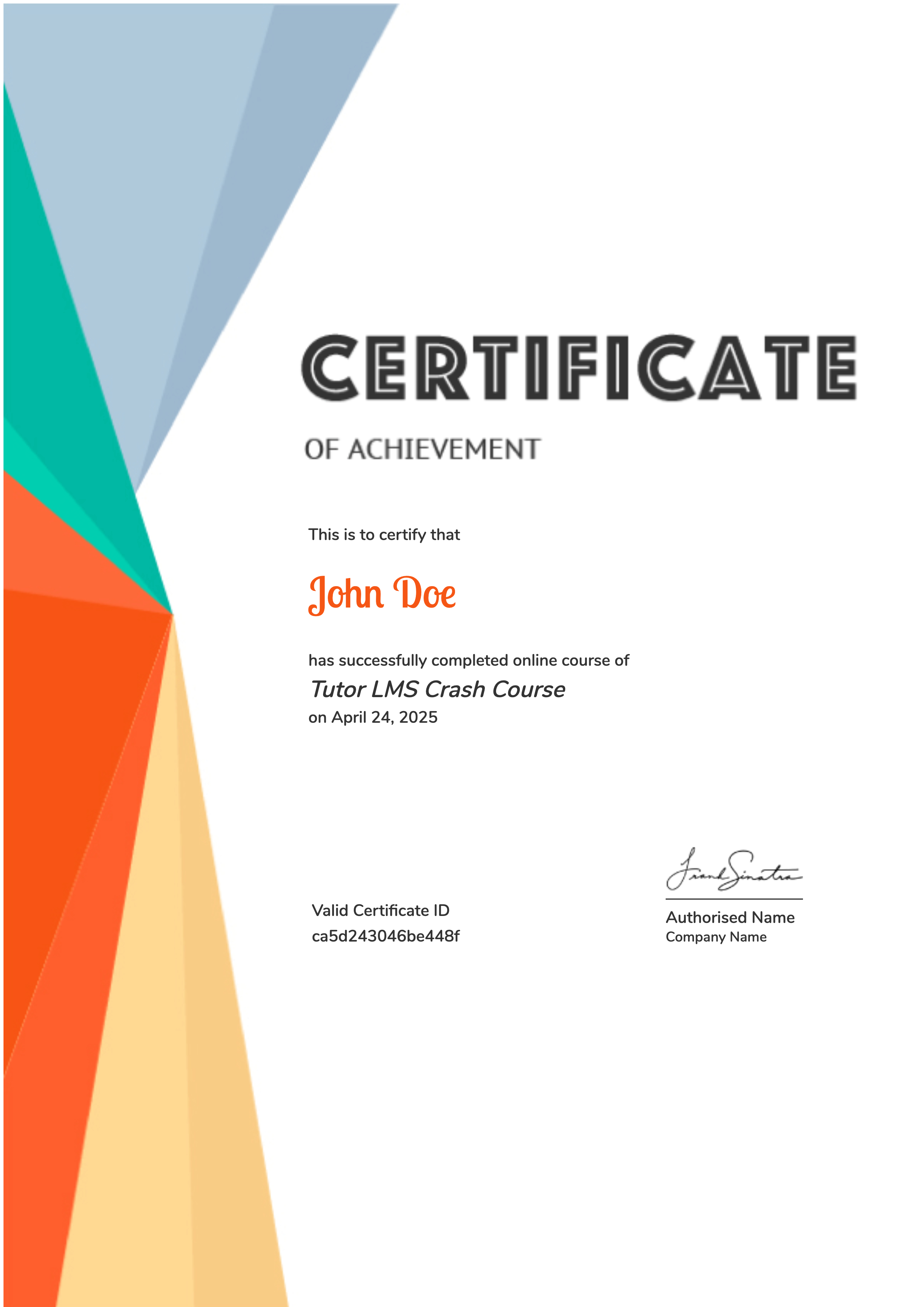
Earn a certificate
Add this certificate to your resume to demonstrate your skills & increase your chances of getting noticed.
Student Ratings & Reviews